

Hollywood quality on an SME budget
How Edelbrand Hofbauer used AI-supported creative expertise to realize an advertising film that would have been unaffordable in the past.
What used to require six-figure budgets, large teams and international productions is now realistic for smaller companies. Thanks to experienced creatives who make targeted use of AI, Hollywood-quality advertising films are being produced at a fraction of the cost. One example of this is the collaboration between Edelbrand Hofbauer and Soda Zitron Media in Vienna.
When attention becomes the greatest currency
Many small and medium-sized companies face the same challenge: they need to be visible, stand out and be emotionally convincing, but operate in a market dominated by large brands with almost unlimited budgets. Traditional forms of advertising are losing their impact, while attention is increasingly shifting to the digital space. At the same time, expectations of quality, look and storytelling are rising.
The good news is that the playing field has changed. New technologies, especially generative AI, now enable production methods that would have been unthinkable just a few years ago. However, the decisive factor is not the tool itself, but the people who use it.
From Hollywood to Vienna and new opportunities for companies
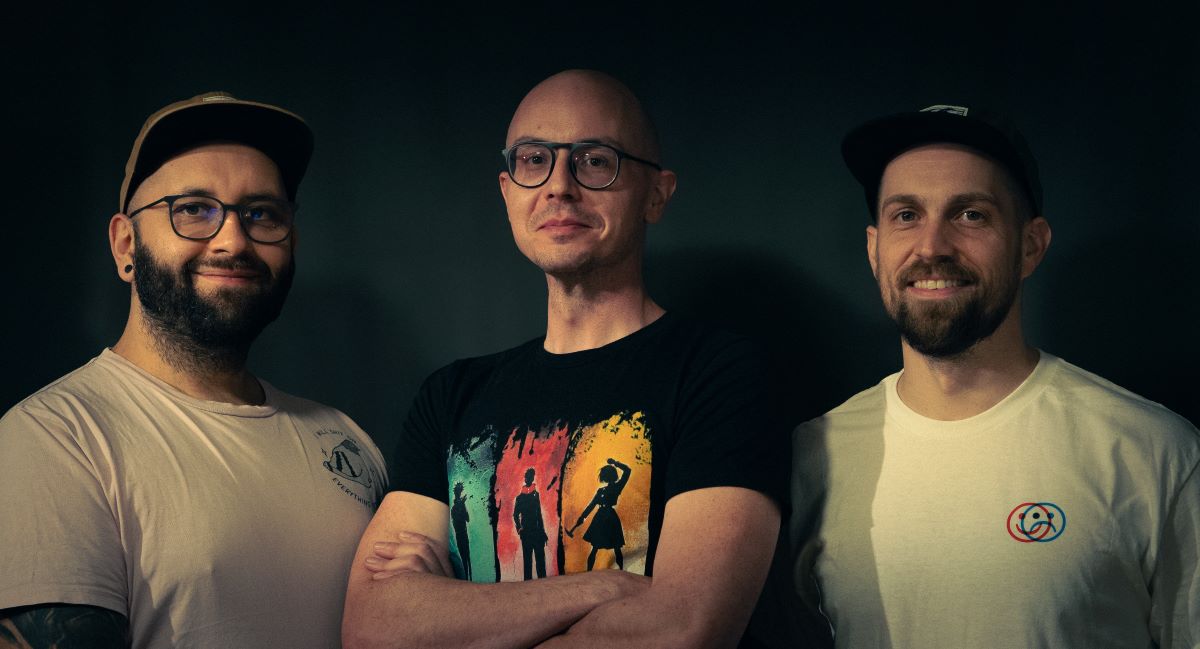
Irdin “Nino” Begic knows what he is talking about. He has worked on international film productions for more than twelve years, including in Hollywood, and came to Vienna for Mission: Impossible. What began as a project became a long-term decision: Nino stayed in Vienna and founded the agency Soda Zitron Media with Stefan Fraberger and Matthias Linsbauer.
“With GenAI, we then saw the opportunity to make our original expertise and passion affordable for everyone,” says Nino.
Together with Soda Zitron Media, he pursues a clear objective: to no longer reserve high-end film aesthetics for big brands. The collaboration with Edelbrand Hofbauer arose from precisely this idea. The aim was to show that even a single distiller from Lower Austria can keep up with much larger competitors in the media if the idea, the know-how and the technology work together.
A horror movie for Halloween with a clear business objective
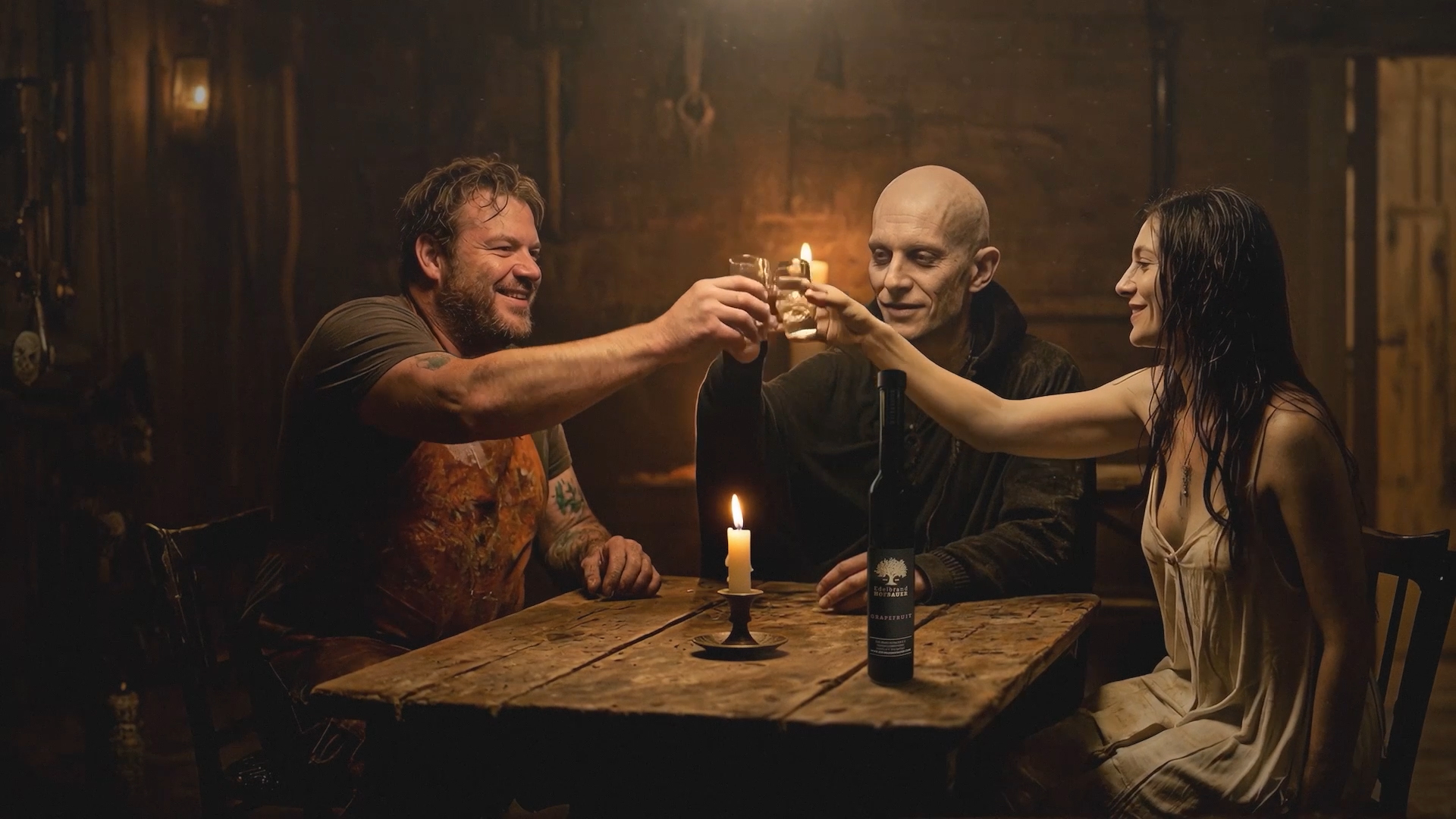
The briefing was deliberately kept simple. The managing director of Edelbrand Hofbauer is a fan of horror films from the 90s. Three brandies, so-called “ghosts” made from grapefruit, poppy seeds and raspberries, were to be staged around Halloween in exactly this style.
The result was a horror spec ad whose production value was estimated by a large German agency at 100,000 to 150,000 euros. However, the ad was actually realized in a fraction of the time and at a fraction of the cost.
“We wanted to set an example that you don’t have to take out a loan to produce a high-quality advertising film.”
Nino Begic
The biggest lever: Rethinking production
The decisive cost saving was not in small optimizations, but in a radically different production approach. There was no classic location, no actors, no set, no camera teams, no travel, no catering. At the same time, it was clear that the film should not look like “AI”.
“We deliberately sought out the challenge of counteracting the common AI slop pitfalls.”
Nino Begic
These include a lack of character consistency, inconsistent color grading or physically illogical images. This is where the real added value of experienced creatives becomes apparent: AI does not replace a basic understanding of film. It reinforces it when it is present.
AI as a tool, not a shortcut
At Soda Zitron Media, the work does not begin with the generation of images, but with pre-production: story, dramaturgy, look development and visual logic are precisely defined in advance.
“AI slop is usually noticeable when basic film basics are forgotten,” says Nino. “Axis jumps, inconsistent color grading or missing film grain are not AI problems, but errors in craftsmanship.” AI supports the process, but does not replace it. Decisions about visual language, rhythm, tension and narrative remain clearly human. Or as Nino puts it: “AI changes job profiles, but doesn’t necessarily replace them.”
Reach is created where target groups really are
The commercial achieved numerous views and clicks. Further proof that high-quality moving images can have an impact today, even with smaller budgets. The decisive factor was not only the look, but also the understanding of distribution channels.
“Today, sales happen a lot via social media,” says Nino. Platforms such as TikTok have developed into central marketplaces. Traditional advertising spaces are losing attention, while the smartphone has become a permanent projection screen. This opens up new opportunities for smaller companies in particular:
“With a really good idea, you can prevail even against big competition with an almost unlimited budget.”
Nino Begic
Control instead of dependency
Another success factor of the project was the technical infrastructure of Soda Zitron Media. Production takes place locally, on the company’s own hardware, without subscription or credit systems.
This creates transparency and planning security. Costs remain comprehensible, feedback loops do not lead to incalculable additional costs, and creative experiments are possible without reaching a “point of no return” at an early stage.
“There’s never a moment when you say: ‘We’ve already invested too much money, let’s just do it,’” says Nino. That’s exactly where projects often end up where nobody is really satisfied in the end.
What companies can learn from this
The collaboration between Edelbrand Hofbauer and Soda Zitron Media impressively demonstrates the potential that lies in the combination of creative expertise and AI-supported production:
- High-quality advertising films are no longer reserved for large companies
- Experience and craftsmanship remain the decisive quality factor
- AI reduces costs, increases speed and expands creative scope
- Smaller companies can be visible, bold and competitive
Or to put it simply: it’s not AI that makes the difference, but creative people who know how to use it sensibly.
Conclusion
For companies that want to communicate today, it is no longer a question of whether they use new technologies, but how. Those who rely on experienced creatives who understand AI as a tool and retain control over the entire process can achieve an extraordinary impact with a manageable budget.
Edelbrand Hofbauer has led the way and shown that Hollywood quality is no longer a question of company size.