
Stronger Than Yesterday: How Creativity Can Provide Direction in Times of Change
Creating a new brand that is embraced by thousands of people is a long process. When the rehabilitation division of a major healthcare provider faced the challenge of reinventing itself following a carve-out, the focus was not on superficial changes, but on identity, direction, and the future. In collaboration with the creative and strategy teams at KISKA, this led to the creation of VITREA—a brand that demonstrates how creativity can guide companies through change processes.
Change is now a part of everyday business life. Companies are entering new markets, ownership structures are shifting, and new business models are being developed. Virtually no company remains unchanged over the long term. Yet while processes, structures, and strategies are often carefully planned, the crucial factor of shared identity is frequently underestimated.
Today’s VITREA also faced this challenge. Following the carve-out, approximately 80 facilities in Austria, Germany, and Switzerland needed a new common foundation. The locations had different areas of focus, established cultures, and strong regional roots. What was missing was a unifying narrative. For the brand and design agency KISKA, it was therefore clear from the outset that this project could not begin with just a logo and design.
Listening Before Creating
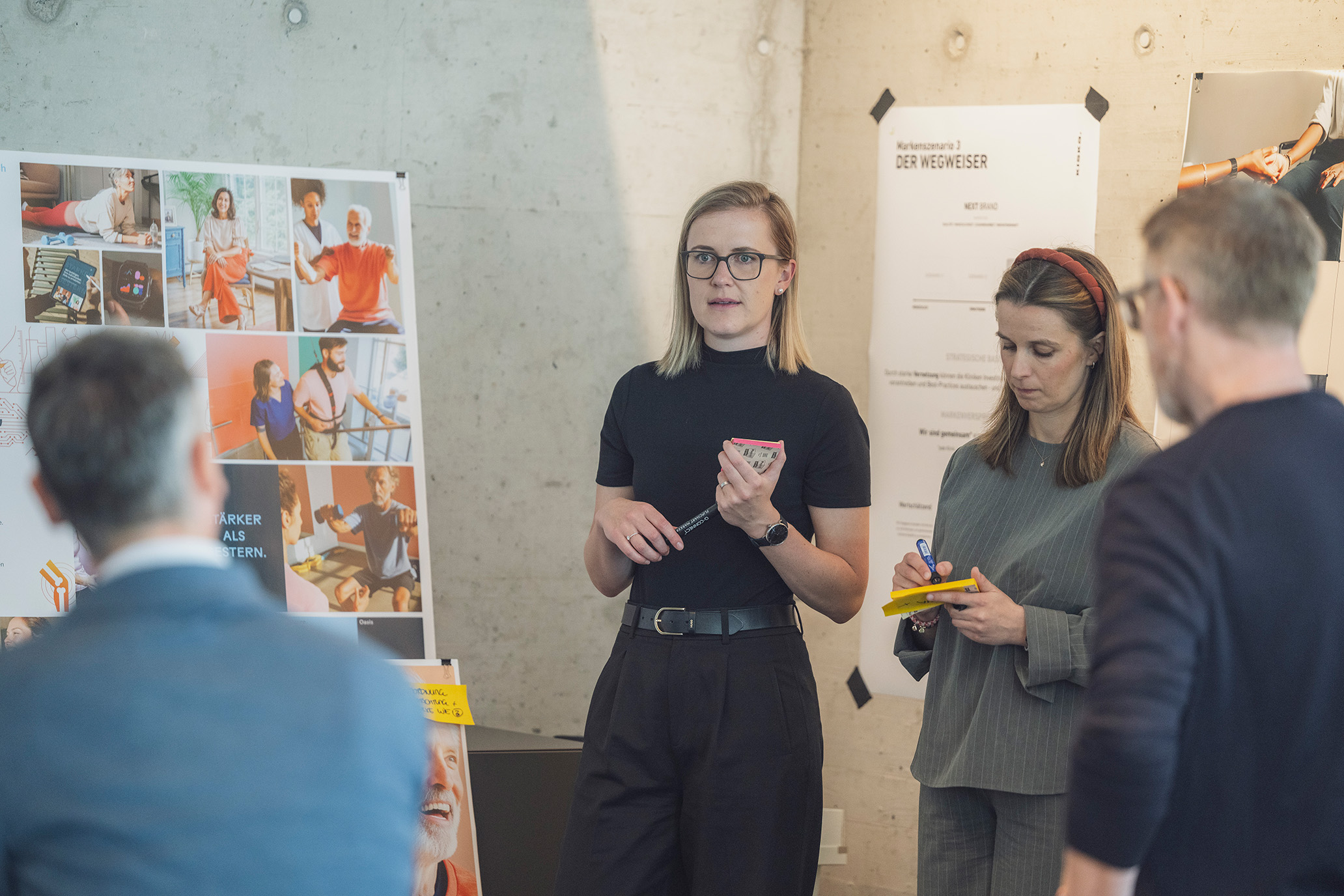
“VITREA was created during a period of major change,” explains Client Director Clara Kendler. “That’s why we approached strategy and design collaboratively from the very beginning.” The most important step was to involve the people who shape the organization on a daily basis. Instead of making assumptions, we listened. Through workshops, focus groups, interviews, surveys, and clinic visits, the team gathered insights from all levels of the organization. The goal wasn’t to collect as many opinions as possible, but to discover what holds this organization together at its core.
It quickly became clear that the most powerful answers were already there. “It became evident to us that employees don’t talk about cases, but about people and their personal progress,” said strategists Anneli Eddy and Lisa Dachs. A seemingly minor observation that reveals a great deal about the organization’s culture.

The common thread in a diverse organization
When people think of rehabilitation, they often think of medical services. However, our research showed that in the day-to-day operations of these clinics, the focus is on something else: personal development. People come to these facilities to become fitter, more independent, or healthier. Progress is rarely dramatic; rather, it happens step by step. This insight became the foundation of the new brand.
At the same time, the analysis revealed something else. The organization already embodied many qualities that are not a given in the healthcare industry. Professional expertise, innovative strength, collaboration, and a distinctly human approach had long been firmly established at the various locations. The task, therefore, was not to invent something completely new. Rather, it was about making visible what was already there.
An important insight also emerged with regard to the competition. While many healthcare brands focus either heavily on medical expertise or heavily on patient-centered care, VITREA combines high professional quality with a consistently human perspective. It is precisely this combination that makes the brand so distinctive today.
When Participation Becomes More Important Than Perfection
In transformation projects of this magnitude, a wide variety of interests come into play. Different countries, different departments, and numerous locations inevitably bring with them differing expectations. Consensus does not emerge automatically.
For KISKA, it was therefore clear that participation had to be organized in a structured way. Workshops, interviews, focus groups, and digital surveys ensured that a wide variety of perspectives were incorporated. However, one key principle was essential: participation does not mean arbitrariness.
“Our goal was never uniformity,” Anneli and Clara emphasize.
The new brand was intended to provide direction without overshadowing local characteristics. Each location should be able to retain its individual expertise and regional ties, while at the same time fostering a shared identity. Transparency was therefore the key to success. Decisions were made by a core team, explained in a clear and understandable way, and communicated throughout the entire process. A live ticker, a launch livestream, and local activities ensured that the development was visible to everyone. This not only created a new brand but also built trust in the change process.
The moment a brand becomes a community
Many rebranding projects end with the launch. New colors define the company’s communications, the website shines in new splendor, and fresh, new business cards are proudly handed out. After that, the most difficult part often begins: actually embedding the new brand within the company.
The official brand launch was also a special moment for VITREA. Employees from different countries and locations gathered in Vienna or followed the launch online. But the most important success didn’t become apparent until afterward. It wasn’t evident in presentations or brand guidelines, but in everyday life. “The most lasting validation came afterward. Seeing how employees bring VITREA to life on social media and in their daily work shows that the brand wasn’t just introduced—it was truly embraced,” says Rouven Steinke, Creative Director. This is precisely what distinguishes a design project from a transformation. A brand doesn’t become successful simply by being visible, but by people identifying with it.
What companies can learn from this
The story of VITREA powerfully demonstrates that creativity can achieve far more than just communication or design. Creative professionals create spaces for guidance, dialogue, and shared understanding, especially when companies are facing profound changes.
Based on the project, the KISKA team has developed several recommendations for managers.
The most important thing: Start with people, not with design. Anyone who wants to transform a brand should first understand which individuals are critical to the success of the transformation and what needs, experiences, and expectations they bring to the table.
It is equally important to organize the listening process systematically. Participation does not happen by chance. It requires formats, structures, and transparency regarding how insights are actually incorporated into decisions.
Furthermore, every change requires clarity. Major transformation processes demand openness to different perspectives. At the same time, people need guidance, clear decisions, understandable communication, and a clear explanation of “why.”
Another point deserves special attention. The rollout should never be viewed as a single launch day. A new brand isn’t created in an afternoon, nor is it established in a single day. It grows through communication, shared experiences, and visible progress.

More Than Just a New Name
Today, for the first time, VITREA is creating a unifying framework for countries, locations, and departments. This makes communication easier, collaboration closer, and our internal and external image more consistent. At the same time, it leaves room for the individual strengths of each location. Successful brands aren’t created by eliminating differences; they emerge when diversity is channeled toward a common direction. For companies facing change processes, this is a valuable message: Creativity does not begin with design. It begins with the ability to bring people together, to listen, and to develop a shared future from many perspectives.
That is exactly how VITREA came to be. Not from a new logo, but from the question of what connects people when everything else is changing.