
Creative Transformation
“Gamechanger Energy”
Energy crisis: Seizing the opportunity for change with the creative industries
The energy crisis is putting companies under cost and change pressure and is further fuel for a profound change that presents you with challenges, but also offers the opportunity for a threefold transformation and new value creation in the interplay of digital, ecological and social transformation.
The creative industries experts are agents of change. They support companies in meeting the challenges of the triple transformation with new, different approaches and finding new solutions.
Powerful innovation through creativity: companies on the road to the future
The challenges of today’s economy require companies to constantly adapt and evolve. Even established companies with well-established business models are currently under considerable pressure to keep up with the changing times.
The so-called triple transformation – ecological change, digital transformation and social change – places high demands on the adaptability and innovative strength of companies. This requires the creative sector’s ideas and innovative strength as a partner in change, for example:

Innovative energy concepts
Creatives can help to find company-specific applications for technological progress and develop cross-sectoral, innovative energy concepts that drive ecological change. This includes the design of sustainable energy infrastructures, the use of renewable energies and the integration of environmental technologies.

Digitization and efficiency
Smart energy savings and solutions: Digital transformation is enabling the development and implementation of smart energy solutions. Creatives can help design digital apps, platforms and technologies that promote energy efficiency, monitor energy consumption and optimize the use of renewable energy.

Social change and awareness-raising
Communication and awareness-raising: Creatives are crucial in communicating environmental awareness and sustainable behavior. Through creative campaigns and information materials, they can raise awareness of the sensible use of energy and promote changes in consumer behavior.
The spark of innovation: Exciting potential in collaboration with creative professionals
Tips from the
creative experts
for solo self-employed people


New ways to reach customers
Tailor-made distribution channels and models to shorten the value chain.
Adapted sales channels and models help companies to set more flexible prices and ensure long-term success. Creatives help to better understand customers and find new sales channels. They also know how to find important partners and build successful collaborations for marketing, communication and delivery.
Solutions from creative minds
“Experience shows that the difficulty lies not in developing new or possibly joint sales strategies, but in finding the right players with whom implementation is possible. Associations or networking events such as those organized by the specialist groups of the Austrian Economic Chambers are recommended here. Social media also offers many opportunities to network and exchange ideas in groups on various platforms such as LinkedIn.”
Many entrepreneurs see their target groups and sales channels as rigid. However, competition is fierce in established markets and rigid structures offer far too little flexibility. Bold, creative sales channels open up new opportunities. One example: a porcelain manufacturer integrates its products into an Italian delicatessen, where customers can experience the goods directly.

Diversification makes you crisis-resistant
The distribution of sales channels and customer groups increases crisis resilience, as the entrepreneurial risk is better spread. However, this requires courage and a very deliberate strategy. How long will I test new approaches? What goals am I pursuing? Is my target group interested? These questions are crucial.

Cooperation as the key to success
Cooperation is essential for new sales channels. Which companies are interested? Who has experience? Cooperations shorten value chains and offer economic advantages. Partnerships also make it possible to test distribution channels with higher costs. An example: a butcher and a barbecue rental company create synergies and unique offers.
Creative support for new paths
Creatives can help with networking and developing specific sales channels. They not only know the latest models, but also understand the economic potential behind them.

Business know-how is crucial
Companies should build up solid business know-how at an early stage. Objective evaluation of the effects of different sales channels and knowledge of contribution margins are essential. A seemingly uneconomical channel can have a high advertising value.

Key questions for identifying new paths
Where do people not expect us? Where can we create a unique selling point? Which cooperations outside the industry would be possible? Creatives help answer questions like these and identify new, promising sales channels.

Saving resources through cycles
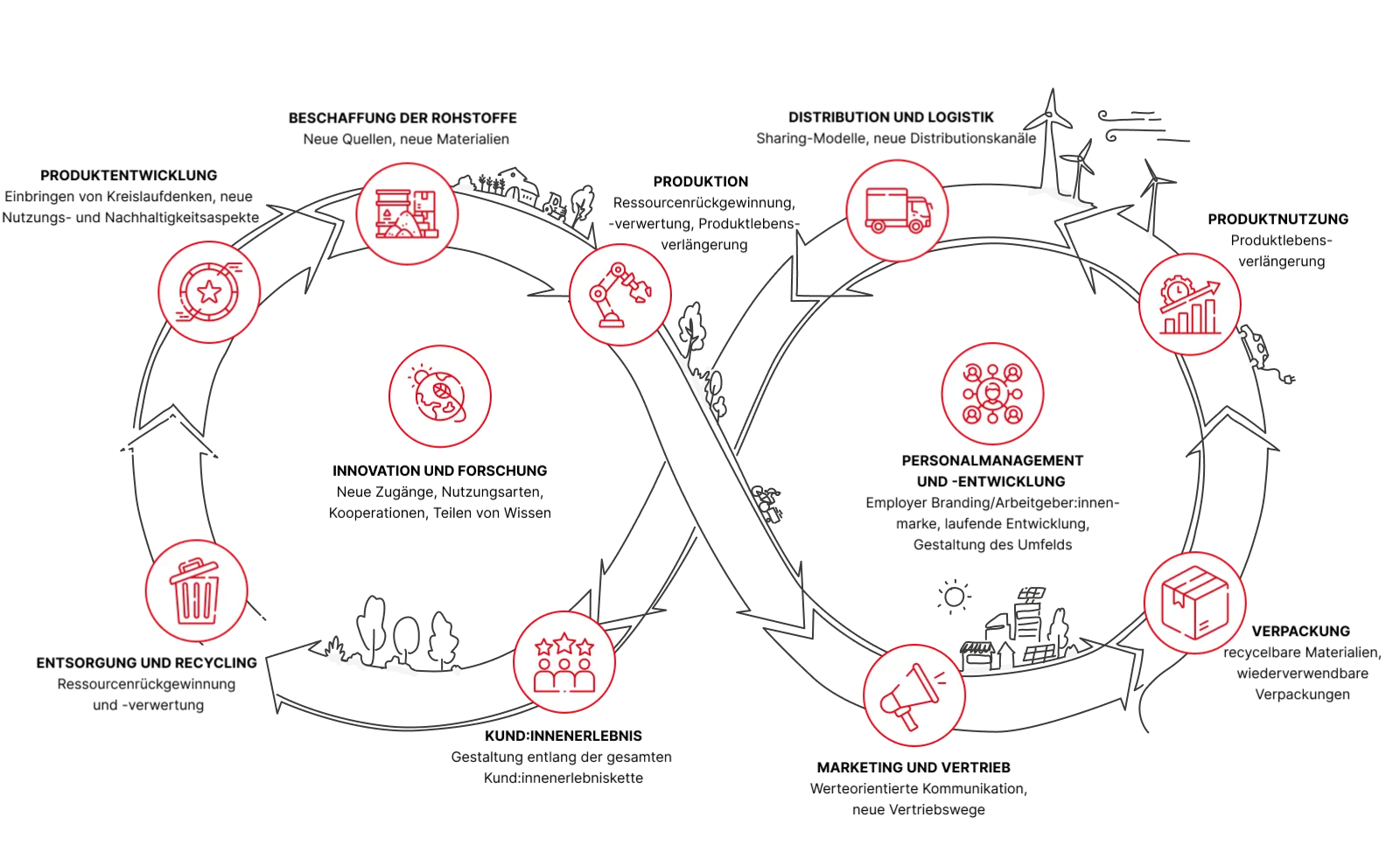
Closing material cycles and using residual materials to save valuable resources.
Saving resources is not only environmentally friendly, but also helps entrepreneurs to reduce costs and use existing resources more efficiently. This can include reducing waste, recycling leftovers and saving on packaging in production and on products themselves. Creatives can help to analyze the situation, ask specific questions to save resources and uncover potential opportunities for cooperation. Using creative methods and design processes, they help to develop customized approaches for each company.
Solutions from creative minds
“When waste prevention becomes an internal company goal, there are many starting points that can lead to success: From reusable packaging partners to incentive systems for packaging avoidance, in-house order optimization, on-demand production, planning tools (e.g. AI-supported software) and the recycling of overproduction, to name just a few of these starting points.”

Focus on saving resources
As creatives, we ask companies precise questions in order to find the most effective lever for savings together. Is it about the circular economy or does optimization start with the range of products in the portfolio? A precise analysis of the value chain¹ and the product range is crucial in order to question the use of materials and minimize waste. The motto: the best waste is the waste that is not produced in the first place. Companies can effectively reduce resources through improved planning, on-demand production and order optimization. Creatives help to develop new offerings and optimize the customer experience.

Sustainable use of residual materials
If residual materials are nevertheless generated, there are opportunities for internal reuse or for sale to processors. Materiality analyses reveal potential for the environment and finances. Workshops, moderated by creative minds with cross-industry insight, enable a holistic view. The diversity of impacts is considerable. Food production accounts for around 30 percent of global greenhouse gas emissions, almost half of which are attributable to animal production. Collaboration with designers also holds great potential for designing products in such a way that fewer residual materials are produced or repairs are possible (design to repair).
¹ The value chain describes the entire process by which a product or service is created, from the extraction of raw materials to the end customer. It includes all activities that contribute to value creation, such as production, sales and marketing. A precise analysis of the value chain enables companies to identify efficiency potential and make optimum use of resources.

Share resources – save costs
Rethinking usage models and infrastructure.
Cooperation and resource sharing offer businesses a significant opportunity for the future, especially in an increasingly interconnected and globalized economy. By collaborating with other companies, smaller businesses can share resources such as technology, expertise and market access that would otherwise be difficult to achieve due to cost and scaling constraints. This type of collaboration also enables small businesses in particular to increase their competitiveness by gaining access to new markets and customers, increasing their innovation capacity through the exchange of ideas and best practices, while reducing costs through shared investments and resources.
Solutions from creative minds
“Many people still shy away from collaborations. Yes, it is relationship work, it is about trust and possible conflicts. However, this is offset by entrepreneurial and personal benefits that need to be developed step by step. We will only be able to successfully meet the challenges of the complexity of these times if we work together.”
Cooperation – the 1×1
To find out who could share entrepreneurial resources with your company and would be suitable for cooperation, you can consider the following steps:
- Define clear goals: Clearly define which resources you would like to share and what you hope to gain from a collaboration. This will help you to search for suitable partners in a more targeted manner.
- Network analysis: Start by analyzing your current network. Identify business partners, suppliers, customers and other contacts who are potentially willing to cooperate.
- Competitor analysis: Examine your competitors and their cooperation strategies. Sometimes even competitors can become valuable partners, especially when it comes to non-competitive aspects.
- Pilot projects and small initiatives: Start with small collaborative projects to test the potential of working together before making larger commitments.
- Building trust and maintaining relationships: Good business relationships are based on trust. Invest in building and maintaining relationships.
- Feedback and recommendations: Ask your network for recommendations. Existing contacts can often make valuable recommendations.
- Flexible and open attitude: Be open to unconventional partnerships and innovative cooperation models. Flexibility can lead to fruitful and unexpected collaborations.
- Written form: The more important the more written, is the motto for cooperation. Precisely because future collaboration is important to you, written and signed agreements – from the start to the ongoing collaboration and all the way to the end – are an important basis. This allows you to effectively identify potential partners who are willing to share resources and enter into a successful cooperation with your company.

Sharing instead of owning – sharing economy
The sharing economy is fit for the future because it promotes the efficient use of resources, sustainability and accessibility. It enables the maximum utilization of existing infrastructure, goods and services, which leads to a reduction in waste and environmental impact. At the same time, it offers economic opportunities to broader sections of the population through shared access to resources and promotes a more inclusive economy. Sharing economy supports innovation and adaptability by enabling new business models and strategies in a rapidly changing global economy.

Good for the earth – good for the economy
Cooperation promotes more sustainable business practices, as resources can be used more efficiently and environmental impacts can be minimized through joint initiatives. In a world where flexibility and adaptability are crucial, cooperation offers small businesses a way to pool their strengths and overcome major challenges together.

Credibly sustainable
Improved communication of activities in the area of sustainability.
In the future, climate protection-related measures and a clear, value-based focus will become increasingly important for companies. This is not only crucial to save resources and energy and to counter the threats posed by climate change, but also because customers increasingly expect companies to take more responsibility. It is therefore important that companies emphasize their positive efforts and creative experts can help to communicate these authentically and position the company accordingly.
Solutions from creative minds
“Change is only possible with the right employees. Entrepreneurs should invest heavily in the education and training of their employees to ensure that they understand the principles of sustainable management and can put them into practice.”

Create clarity and communicate
The green transformation often requires an adjustment of a company’s positioning basis from a communicative perspective. The first step is to analyze the company’s own values and attitudes. Creative professionals provide support by asking specific questions, differentiating, scrutinizing and sharpening and thus developing a clear positioning with the entrepreneurs.

An “attitude compass” for clear decisions and communication
A clear “attitude compass” helps entrepreneurs make decisions and clearly communicate their own values. What a company stands for is crucial for customers who are looking for products and services that align with their own values. Once the company’s values have been aligned, it is important to find and tell the company’s stories. These can be used to show what is already being done to protect the climate and the environment or what things are being planned and started to be implemented.Focus on clear messages and employee trainingFocused messages and clear measures are more effective than superficial diversity. The target group is addressed appropriately through elaborated stories and their communication on deliberately selected channels. This requires perseverance and, if necessary, adaptation in communication. It’s not just about potential customers, but also about training employees. They play a crucial role as the company’s ambassadors to the outside world. The positioning must be communicated authentically, and for this, entrepreneurs need informed employees. Any investment in their training is therefore crucial to ensure that the principles of sustainable management can be understood and implemented.

New offers
Product innovations and range design at the cutting edge.
In order to conserve resources, save energy and promote environmental friendliness, the development of new products and offers is an effective lever. This measure makes it possible to react more flexibly to changes, put together interesting offers and also discover more environmentally friendly resources and production methods. Creatives can support this with creative methods and design processes to drive innovation that suits your company and at the same time appeals to new customers.
Solutions from creative minds
“Cooperation is the magic word! Design thinking offers many interesting and easy-to-use methods such as the stakeholder map, personas or customer journeys. It is particularly interesting to work together in a team and to look at things with someone outside my company and my industry – a trusted person or an expert from the creative industry – and to discover potential and develop (collaborative) ideas together.”

Alignment through a clear vision
The vision is the North Star of a company and everything should be aligned with it. In addition to business considerations, it is crucial for focusing and making clear decisions, for example when reducing or changing the product portfolio. The question is: Which product is the essence of my vision and best tells my story? The vision also helps in collaborations: who shares similar values, who could be a good fit for me and how can we tell a stronger story together?

Analysis of target groups and trends for sustainable success
In addition to the vision, the regular analysis of target groups and trends is essential in order to stay up to date as a company. This offers opportunities for saving resources and sustainable management, which is becoming increasingly important for many target groups and can also reduce the company’s own use of resources.

Design thinking for customer-centric innovation
Two methods from “design thinking” are particularly helpful for discovering potential: exemplary personas can have fictitious, but data-based profiles that represent different customer groups. They can be used to view products, services and processes from the customer’s perspective. Customer journeys, which represent the experiences of the personas along the entire buying process, help to identify needs, pain points and opportunities. These easy-to-use methods provide many insights and support customer-oriented innovations.

Powerful impetus from the
creative industries

Positioning and branding
Identify the company’s unique selling points and position itself accordingly, thus differentiating itself from the competition.

Marketing and storytelling
The expertise in various marketing disciplines, including market research, advertising, positioning, brand communication and storytelling. As well as creating engaging and relevant content, often in a digital context, to reach and engage target audiences.

Green Marketing
Align the corporate strategy with sustainability and create awareness for greater sustainability within the company and among customers.

Product and service design
The design development of products and services in order to optimize their function, aesthetics and user-friendliness.

Experience design and interaction design
Designing holistic experiences for users and customers to promote positive emotional reactions and long-term loyalty.

Packaging design
The expertise in various marketing disciplines, including market research, advertising, positioning, brand communication and storytelling. As well as creating engaging and relevant content, often in a digital context, to reach and engage target audiences.

Circular Design
A design approach that aims to design products and processes over their entire life cycle in such a way that resources can be reused and thus preserved in a cycle.

Sales channels and models
Designing holistic experiences for users and customers to promote positive emotional reactions and long-term loyalty.

Cooperations and partnerships
Strategic approach to searching for, selecting and structuring partnerships, e.g. for collaboration along the value chain

Employer branding
The design and positioning of the employer brand to attract and retain talent and create a positive image as an employer.

Business model development
The design of a holistic concept that ensures the economic success of companies and creates added value for customers.

Data usage and digitization
Designing holistic experiences for users and customers to promote positive emotional reactions and long-term loyalty.

Change management
Strategic approach to searching for, selecting and structuring partnerships, e.g. for collaboration along the value chain

Frugal Innovation
Means developing a strategy for innovation that aims to find cost-effective and efficient solutions to complex problems. This often happens in environments where there is a lack of resources.

How can entrepreneurs make the most of the opportunities presented by change?
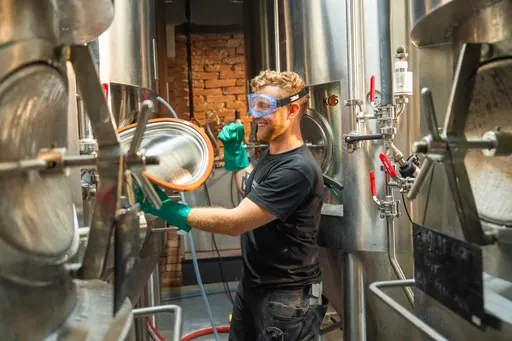
Successful diversification at the Zaungast brewing collective
The Zaungast brewing collective, founded by Martin Wohlkönig in 2020, relies on a diverse sales strategy. The craft beers are sold directly to end customers via its own online store, which not only enables direct contact but also generates valuable feedback.

Sustainable diversification at KRUT
Founded in 2020 by Simon Baur, KRUT makes creative use of food surpluses and focuses on the production of innovative fermented products such as kimchi and kombucha. Under the motto “Save – Ferment – Enjoy”, KRUT integrates the sustainable use of food surpluses as an integral part of its business model.
Kern Tec: Successful circular economy in the food industry
Founded in 2020, Kern Tec is revolutionizing the food industry by transforming previously unused fruit pit waste into innovative ingredients and ready-to-use solutions. The unique technology requires intensive communication and education work as it is novel and challenging.


Genusskoarl: Innovation and sustainability in the world of condiments
Karl Severin Traugott founded Genusskoarl in October 2016 with the vision of high-quality seasonings that not only delight the palate but also show respect for the environment. The clear focus on this vision enables credible communication and promotes continuous innovation, both in products and in collaborations.
Herd Open Kitchen – successful co-working kitchens
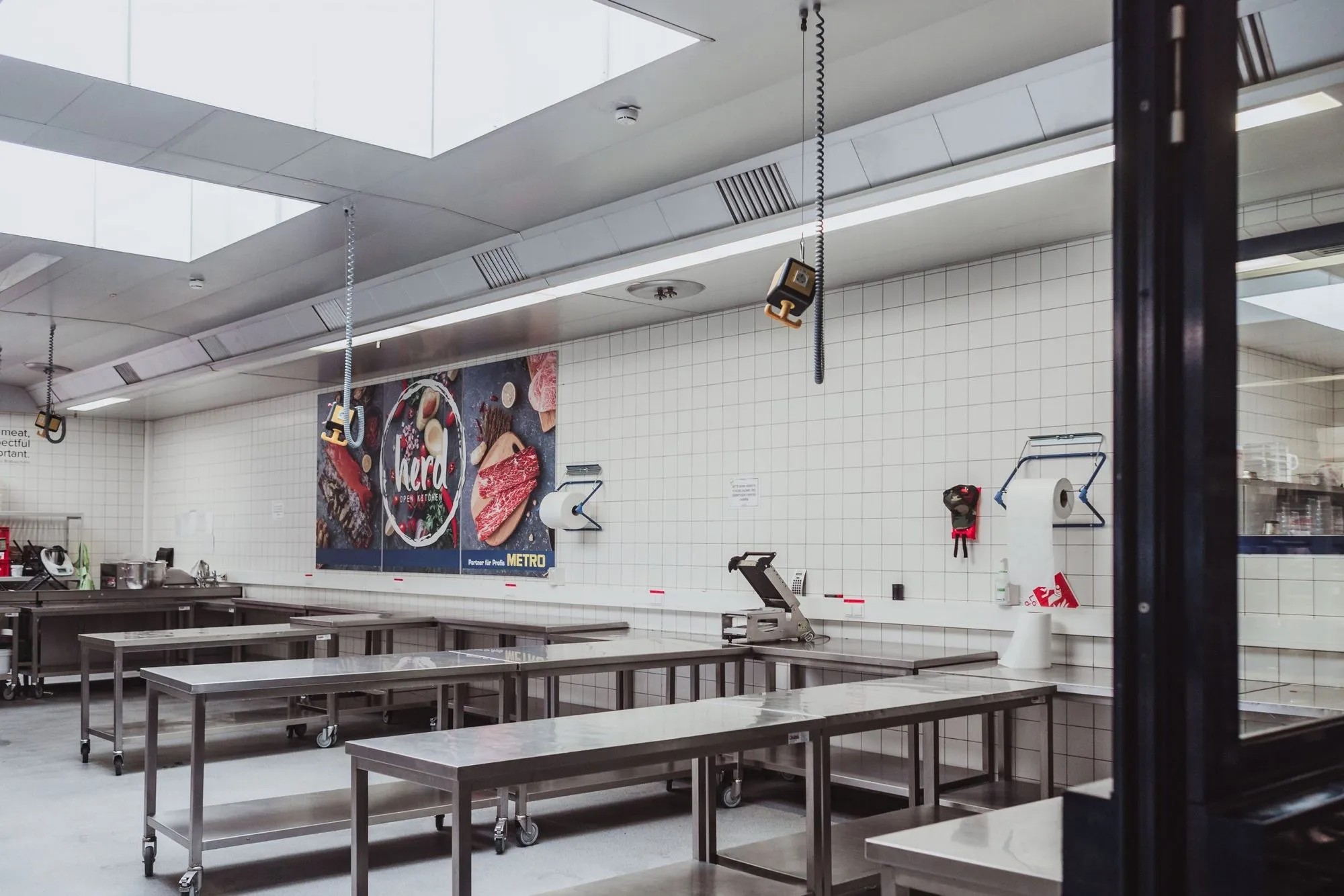
Since 2007, Herd has been offering companies from the food business access to a fully equipped 700m2 production kitchen and sufficient cooling space (the so-called co-working kitchen), as well as access to important partners and networking with other founders.