




Three tips on prototyping
Tip 1
Start with the real problem
Good ideas don’t start with a finished solution, but with the actual problem of a specific person. A professionally implemented idea is of little help if it doesn’t meet a relevant need.
So first describe who you are developing something for: when does the problem occur? How is it solved today? What happens if it remains unsolved? Human-centred design helps you dig deep into the problem – and not fall in love with your own first idea too early.
Hands-on tip
Think of a specific customer and note the last situation in which this problem occurred: what happened and how has it been solved so far?
Reflection question
Which problem would your customers actively want to solve even if your offer did not exist yet?
Reflection question
What can you make visible today without having to fully develop anything?
Hands-on tip
Choose the simplest form in which your idea can become visible, and build or sketch a first version in 20 minutes.
Tip 2
Learn by doing
Prototyping is not about building something finished straight away. A simplified, visible version makes an idea something you can discuss and test – and therefore learn from.
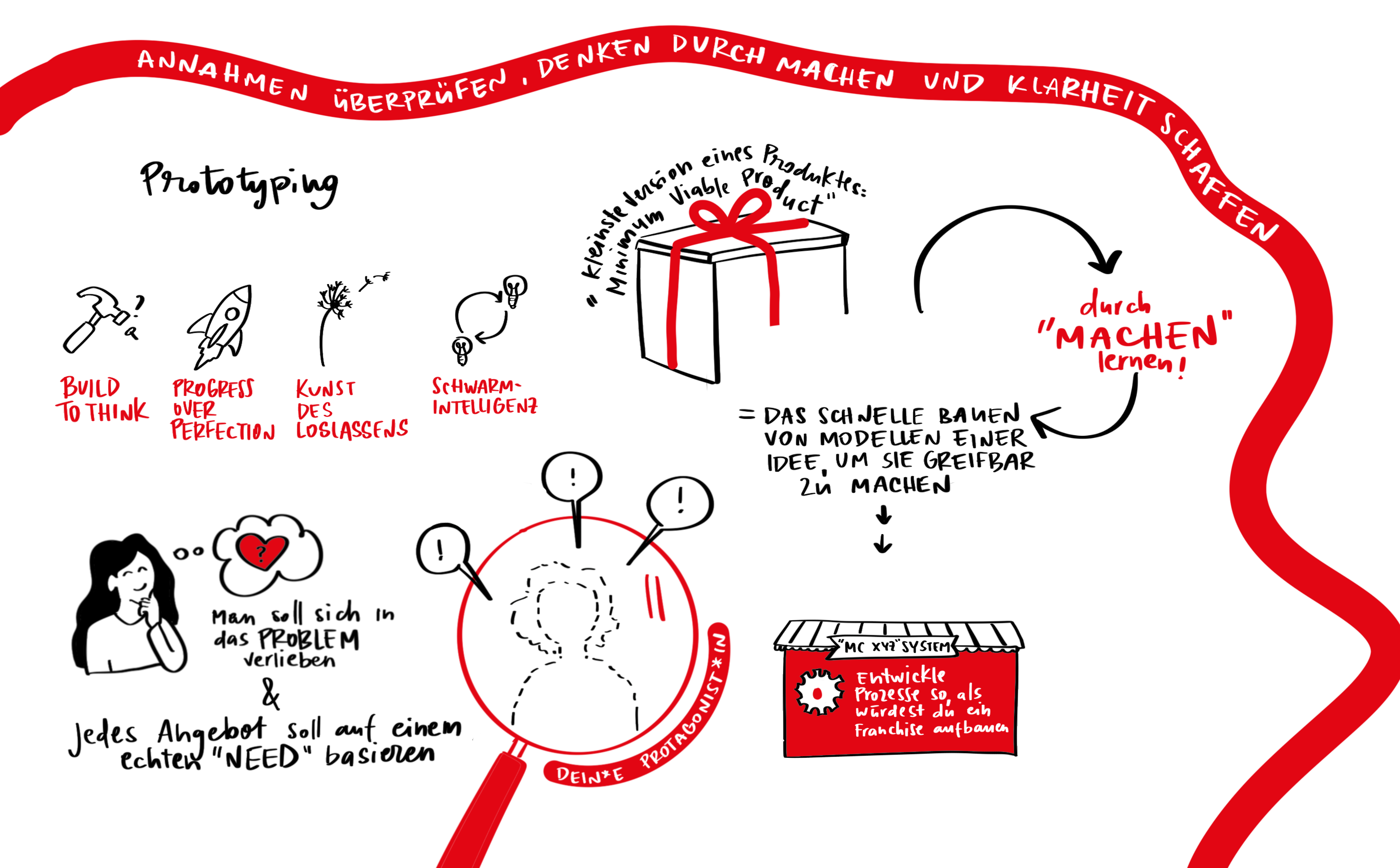
The mindset behind it: build to think, progress over perfection and the art of leaving things out. A sketch, a storyboard, a role play, a paper model or a simple clickable draft can be enough to answer important questions.
Tip 3
Make something visible in seven days
Reduce your idea to the smallest meaningful learning experiment: who is it for? Which problem should it solve? Which part has to become visible? Which assumption do you want to test?
Show your reduced version to a few suitable people. Don’t just ask whether they like the idea, but how the problem is solved today, what they understand and what would happen next.
Hands-on tip
Plan a test with three suitable people within the next seven days. Note beforehand the one assumption you want to test.
Reflection question
Which assumption do you need to test next before investing more time or money?
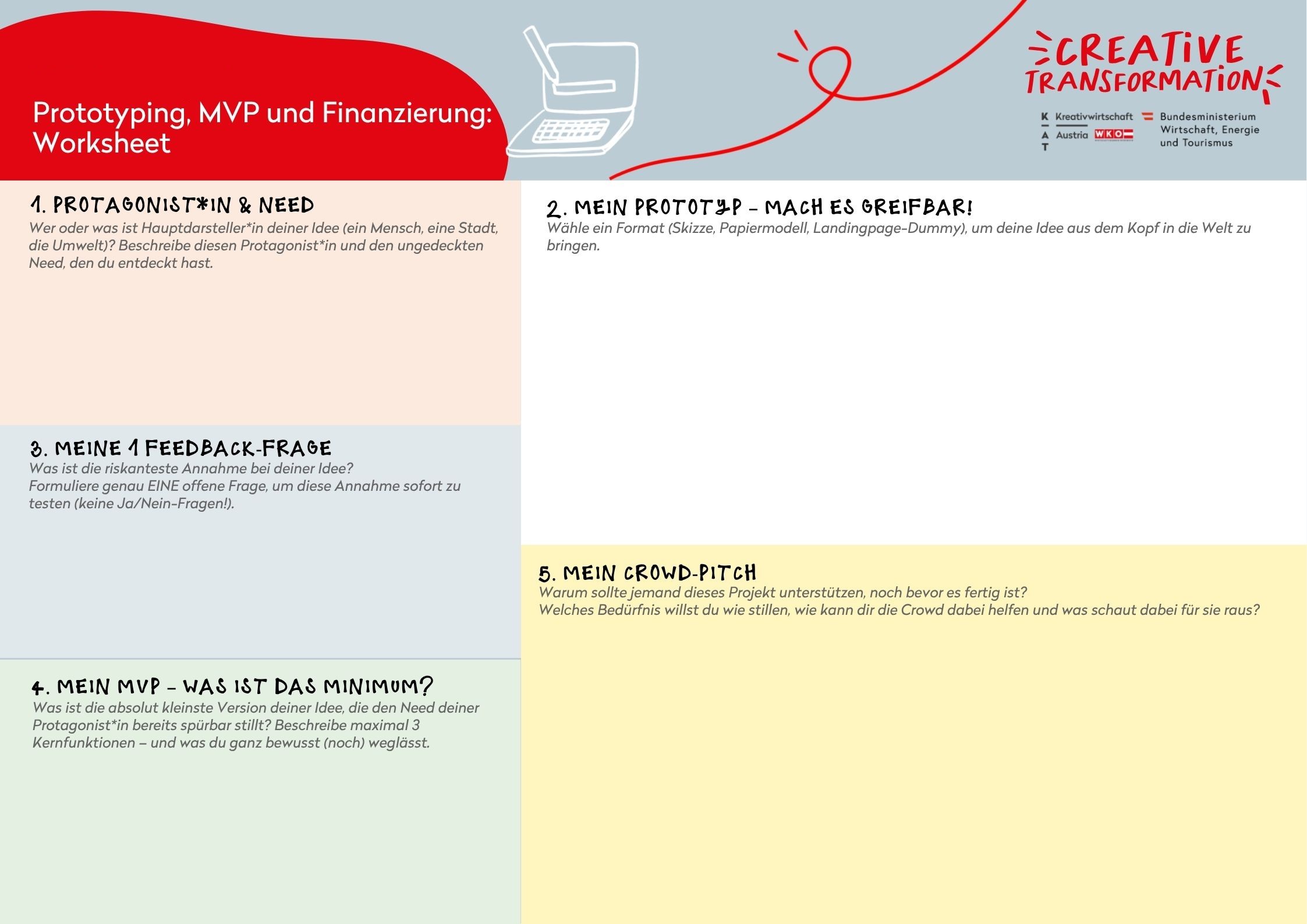
Your worksheet to fill in
With this worksheet by Clôd Baumgartner and Chiara de Eccher, you can try out the method directly on your own business. The questions guide you through the topic step by step.
How it works: print the worksheet in A4 or A3 format, or insert it into PowerPoint as a JPEG and work there with text boxes. Set aside at least 30 undisturbed minutes and fill it in.
Sources: worksheet developed by Clôd Baumgartner and Chiara de Eccher · minimum viable product (MVP) after Eric Ries, “The Lean Startup”, 2011
Want to make an even bigger impact?
1 + 1 is greater than 2. Collaborating with experts from the creative industries is worth it. Get advice from KreativKarl and find the creative industries expert who’s right for you.