




Three tips on gamification
Tip 1
Think motivation, not just information
People often know what would make sense – and still don’t do it. An offer can be excellent in substance and still be used too little if getting started, making progress or taking part is not designed to motivate.
Gamification uses selected elements of game design in non-game contexts. The aim is not to turn every offer into a game, but to make the desired behaviour easier and more attractive: getting started, keeping at it, trying things out, learning, sharing or helping to shape.
Hands-on tip
Define exactly one behaviour you want to make easier – for example starting, returning, completing, sharing or giving feedback.
Reflection question
Which specific behaviour do you want to make easier or encourage among your customers?
Reflection question
What motivates your target group more: reward, progress, autonomy, relatedness, purpose or co-creation?
Hands-on tip
Choose one main motivation and one possible second motivation for your target group. Note a suitable mechanic for each.
Tip 2
Understand different motivations
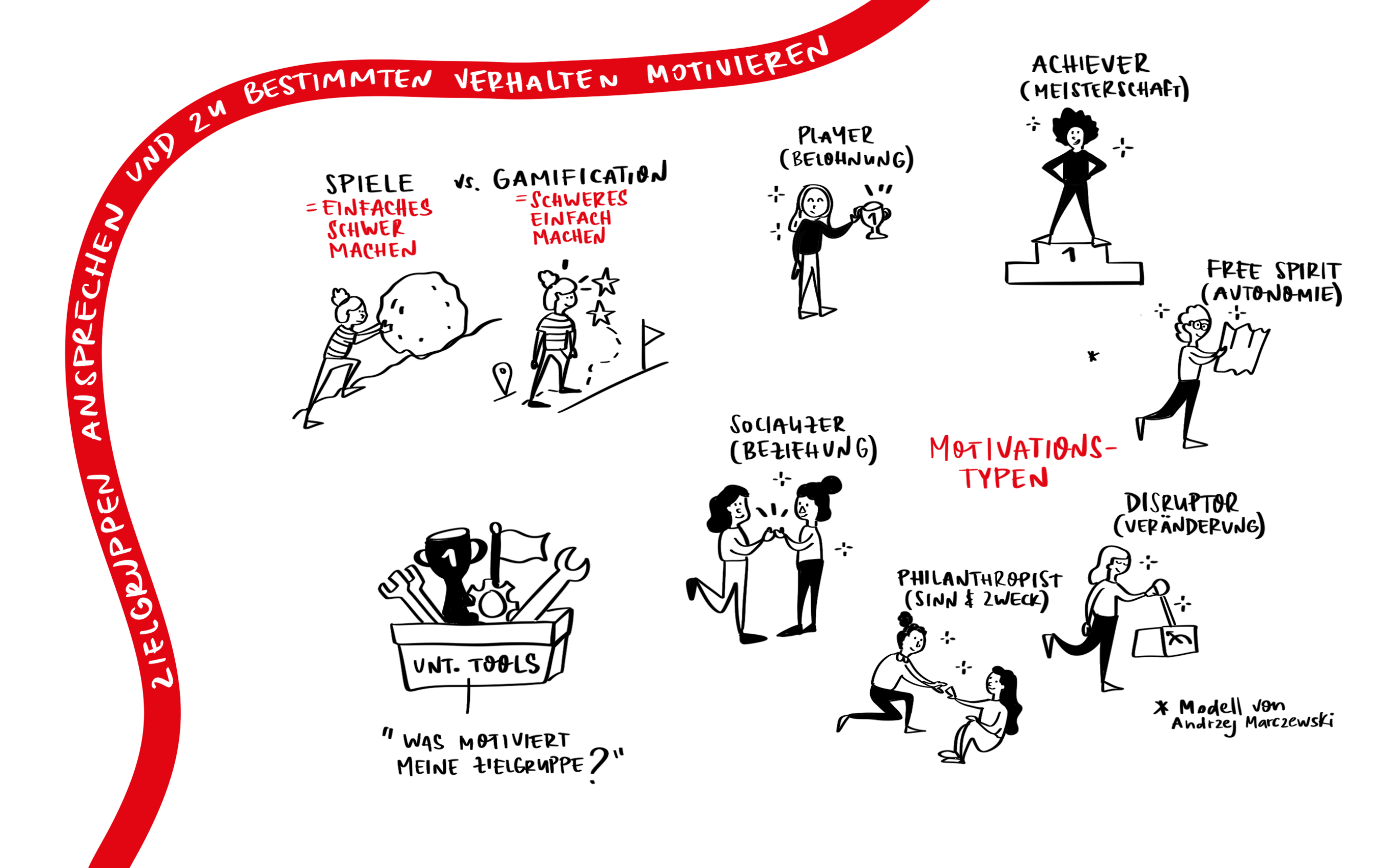
The Hexad model distinguishes six typical motivations: reward, mastery, autonomy, relatedness, purpose and change. Behind them are different needs – and therefore different design options.
Points or levels appeal to some people. Others respond more strongly to choices, exploration, shared tasks, knowledge sharing, responsibility, feedback or co-creation. What matters is consciously connecting motivation and design.
Tip 3
Try out a suitable mechanic
A good mechanic supports a desired behaviour. This can be a challenge, a progress bar, a choice, a buddy system, a feedback format or an opportunity to help shape things.
Start small and observe real behaviour instead of just clicks or approval: do people get going more easily? Are they more likely to stick with it? Is the desired next step actually taken more often?
Hands-on tip
Test a single mechanic for one clearly defined step of your offer and observe for a week what changes in behaviour.
Reflection question
How exactly would you recognise that the mechanic you chose actually works?
Your worksheet to fill in
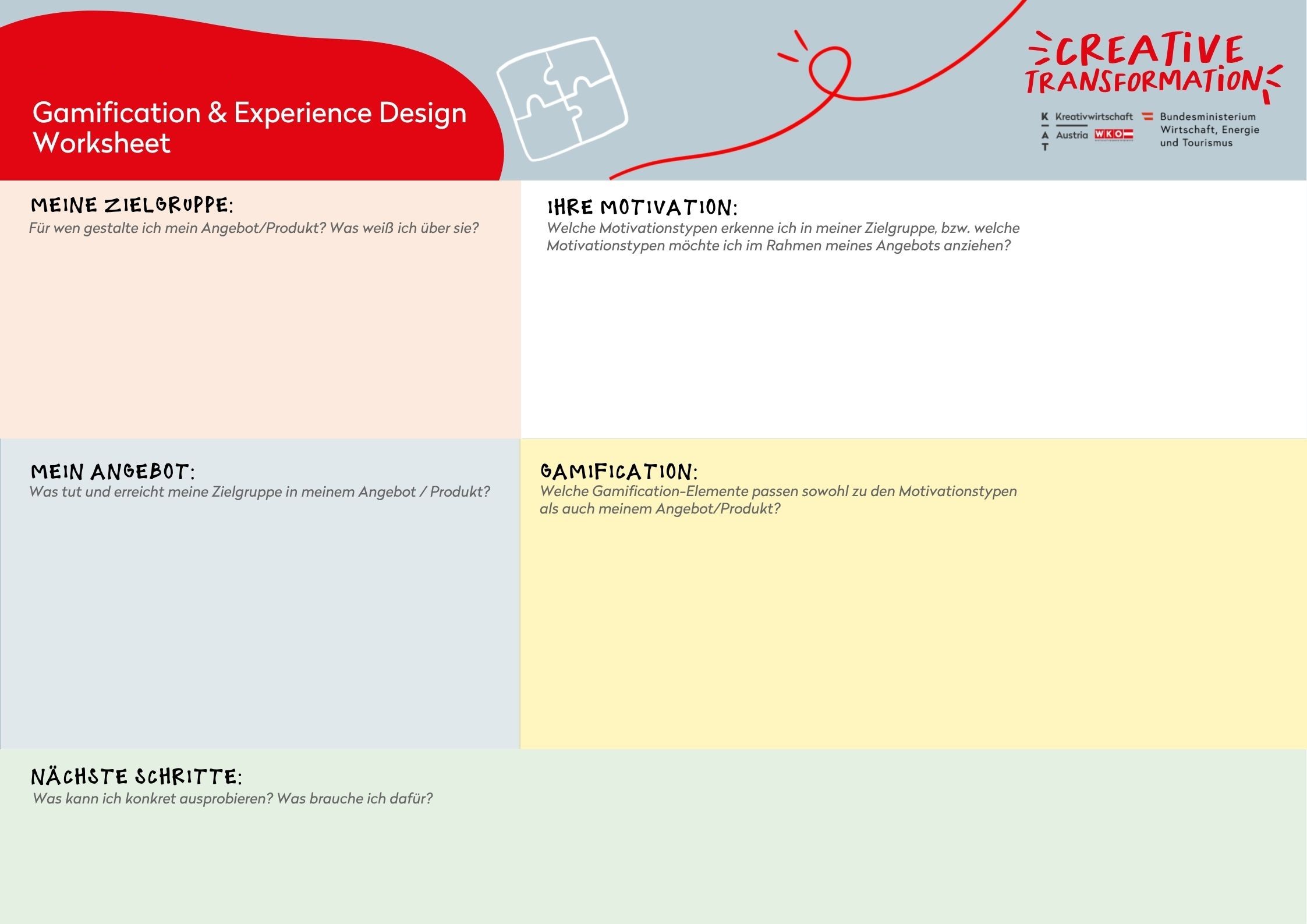
With this worksheet by Lena Robinson and Chiara de Eccher, you can try out the method directly on your own business. The questions guide you through the topic step by step.
How it works: print the worksheet in A4 or A3 format, or insert it into PowerPoint as a JPEG and work there with text boxes. Set aside at least 30 undisturbed minutes and fill it in.
Sources: worksheet developed by Lena Robinson and Chiara de Eccher · Hexad model (Gamification User Types Hexad) © Andrzej Marczewski, 2015


Want to make an even bigger impact?
1 + 1 is greater than 2. Collaborating with experts from the creative industries is worth it. Get advice from KreativKarl and find the creative industries expert who’s right for you.