

A refreshingly livelysustainability report
How digital publications tell stories. Coca-Cola HBC Austria, currycom and the creative Andrés González from our C hoch 3 community rethought a sustainability report together.
At first glance, annual and sustainability reports often appear sober, number-heavy and uninspiring. At the same time, they contain many exciting insights that companies want to convey to their stakeholders, from partners and the media to potential employees. The challenge is to get to the heart of a format that is traditionally considered “must-read” in such a way that it really reaches people and ideally even inspires them. Coca-Cola HBC Austria wanted to do just that: create a report that not only informs, but also brings the target group of consumers to life. The collaboration with currycom communication partners and the creative Andrés González from our C hoch 3 community shows impressively how digital publications make this goal possible and why co-creation is a real success factor.
When a report needs to be more than just a PDF
Annual and sustainability reports are among the most demanding publications for many companies. They should provide information, create transparency and at the same time convey brand values. However, traditional formats such as PDF are increasingly reaching their limits.
The sustainability team at Coca-Cola HBC Austria therefore asked themselves how they could prepare the complex content in such a way that it had a contemporary effect, attracted attention and was really easy to understand. Coca-Cola HBC found the answer with a strong constellation of three: the communications agency currycom, the creative Andrés González, founder of Evodigital, and the company’s own team. The result was a project that shows how much potential there is in collaboration between companies and the creative industries.
A partnership that goes back a long way
The story begins long before the digital sustainability report for Coca-Cola HBC. The collaboration between Andrés and currycom began over fifteen years ago, at that time still in the classic field of graphic design. Over the years, this developed into a trusting, well-established partnership with numerous successful communication projects. When Andrés decided to specialize in digital and interactive publications in 2023 and founded Evodigital, one thing was clear:
“currycom was the first partner I presented the new concept to and they immediately saw the potential.”
Andrés González
This openness was crucial. After all, many companies now know that it is not enough to be familiar with new communication formats. You also have to be prepared to use them. currycom recognized early on that digital publications are not just a new design format, but also a strategic communication tool. They create new ways of telling stories, enhance the user experience and enable a precise analysis of user behavior. The digital sustainability report with Coca-Cola HBC Austria was also created with this in mind.
Why Coca-Cola HBC Austria opted for a digital format
For Coca-Cola HBC, the decision was a conscious and strategic one. The question today is no longer whether digital formats will prevail. The only question is when. Coca-Cola HBC wanted to be one of the companies that not only took this step, but actively helped to shape it. The advantages were obvious:
Better user experience: Digital publications enable animations, moving images, audio and interactive navigation. These are all elements that make content livelier and more accessible.
Stronger brand impact: A brand like Coca-Cola HBC thrives on emotion, dynamism and storytelling. A digital format can convey this brand world very differently than a static PDF.
Economic and ecological advantages: No printing costs, no shipping, fewer resources. A relevant contribution to the sustainability strategy.
Measurability: The ability to evaluate user behavior offered additional added value for Coca-Cola HBC. Among other things, the new format makes it possible to measure which content is read most frequently, where users spend the most time and what really interests them. For future communication projects, this is a strategic advantage that simply does not exist in the classic print or PDF format.
Content that not only informs, but also wants to be experienced
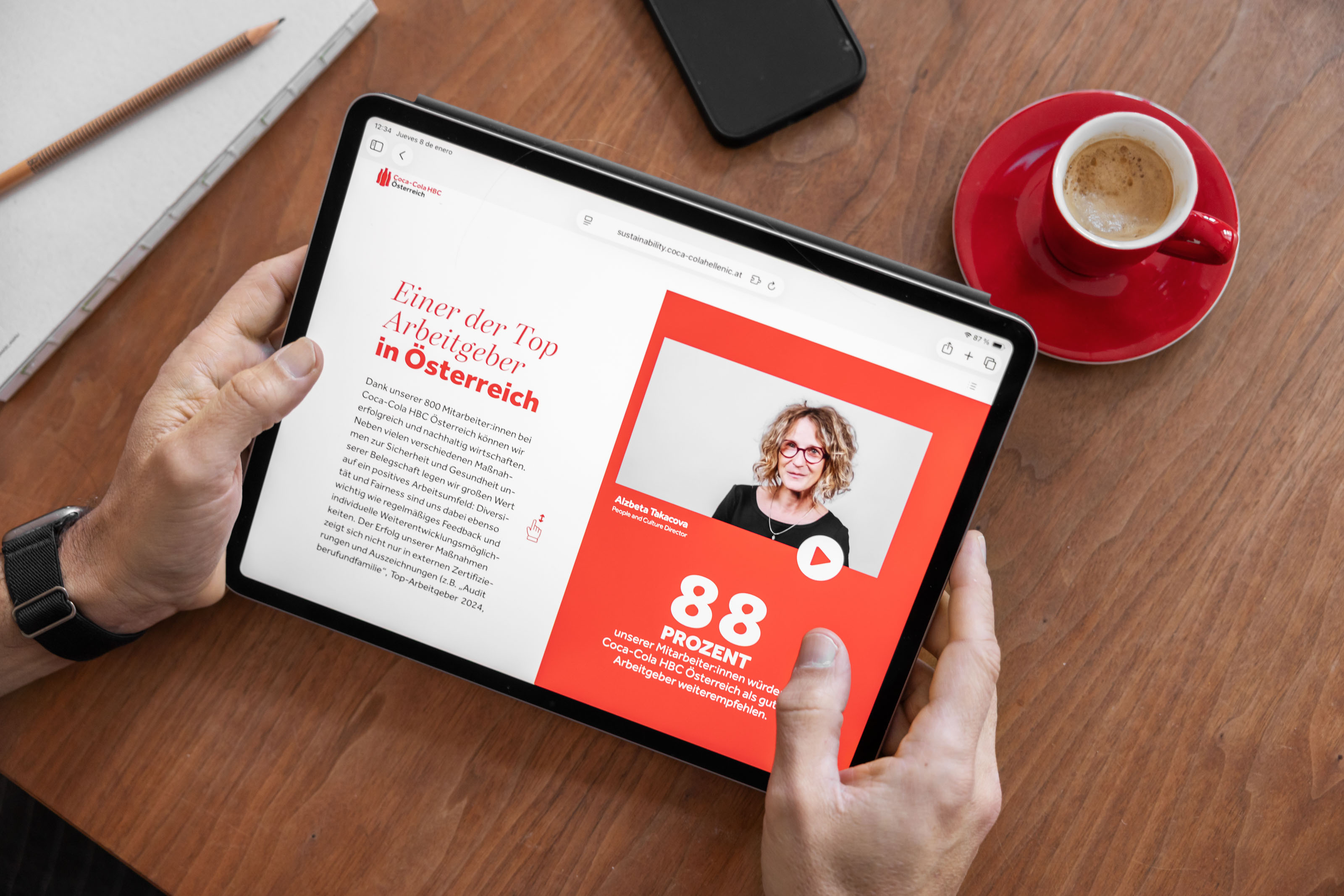
A digital format only works if it is actually used. That’s why Coca-Cola HBC, currycom and Evodigital worked together on a structure that not only presents complex content, but also makes it tangible. For example, video statements were used as a bridge between people and numbers. Heads of department explained their priorities and goals in short video messages. The result was a strong personal connection, more context and a format that makes content more lively than any paragraph of continuous text.
In addition, data visualizations were animated to make connections visible. Tables have been replaced by animated graphics, supported by icons and illustrations. This facilitates orientation and improves understanding, especially for complex topics.
Another example is the multi-level information architecture. Essential content is in the foreground, while more in-depth levels can be displayed if required. This one-click information logic suits the way people consume digital content today: fast, intuitive and self-directed. All of this was done within the existing corporate identity of Coca-Cola HBC in order to keep the brand identity consistent.
Collaboration as a success factor: why co-creation worked so well here
Large brands are increasingly working with creative specialists. They like to bring experienced partners on board to structure the process. In this project, currycom played precisely this role. The agency was responsible for strategic consulting, developed the core messages and acted as an interface to the client. This was crucial for Coca-Cola HBC, as it provided clear processes, transparent roles and professional coordination. For Andrés, this gave him the opportunity to focus on what is his core competence: the visual and digital narrative structure. Content, dramaturgy and interactive elements were created in a constant exchange between all those involved. The result was therefore more than the sum of its parts. In this case, co-creation means pooling skills without anyone losing their role.
Lessons learned from this project for companies
Five clear findings can be formulated from the collaboration that are relevant for many companies:
1. digital publications are not a trend. They are a logical development. The way people consume content has changed. Communication must respond to this.
2. interactive elements increase attention and understanding. The more content is designed as an experience, the longer and more intensively users engage with it.
3. measurability is a strategic advantage. For the first time, companies can really understand which content is effective and which is not.
4. co-creation brings speed and quality. Clear roles, open collaboration and the use of external creative minds lead to better results in less time.
5. choice of format is crucial. A website provides information, a digital publication tells stories. This is the decisive difference for many communication events.
When companies and creative minds create something new together
Coca-Cola HBC Austria’s digital sustainability report is more than just a successful project. It is an example of a larger change. Companies are looking for new ways to communicate their messages. Creatives bring the concepts, methods and ideas to make these paths successful. And agencies like currycom combine both worlds. When these three forces come together, the result is communication that not only informs but also inspires and shows brands how much potential there is in the creative industries.